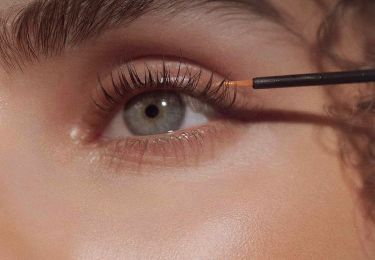
How to Choose a Safe Lash Serum: A Physician's Guide to Ingredients and Ocular Safety

If you have searched online for a lash conditioner, you have probably encountered claims like “clinically proven,” “ophthalmologist-tested,” or “dermatologist-approved” used freely across products with very different levels of supporting evidence. As a physician who has formulated, patented, and published peer-reviewed research on eyelash conditioning, I want to give you a clear framework for evaluating a lash conditioner’s safety profile — the same framework I would use with a patient in my own practice.
Quick Answer
The safest lash conditioners are those that have been independently tested for ocular safety in clinical studies conducted by ophthalmologists under IRB-approved protocols — evaluating visual acuity, intraocular pressure, slit-lamp findings, and tolerance in actual contact lens wearers and sensitive-eye participants. Ingredient family alone is not a safety shortcut: well-designed formulations can be safe when supported by appropriate independent testing and transparent ingredient disclosure. MD Lash Factor offers two physician-formulated options, both backed by independent IRB-protocoled ocular safety studies conducted by ophthalmologists. The original formulation is additionally supported by a peer-reviewed publication in the Journal of Cosmetic and Laser Therapy (2008, PMID 18569264). Independent clinical safety studies have found both MD Lash Factor formulations safe and efficacious.
Why Lash Conditioner Safety Deserves Its Own Conversation
Eyelash conditioners occupy a unique position in personal care. They are applied within millimeters of the cornea, in some cases nightly for months at a time, on a surface that drains directly into the ocular surface and tear film. The standards we use to evaluate a face cream are simply not adequate here. A lash product needs to be evaluated through the lens of ophthalmic safety, not just dermatologic tolerance.
The U.S. Food and Drug Administration (FDA) has issued warning letters since 2011 to manufacturers of over-the-counter lash conditioners that failed to disclose active ingredients on their labels, made unsubstantiated drug-like claims, or were marketed without adequate safety documentation. The agency’s concerns have not been with any single ingredient family in isolation, but with the gap between what was claimed and what was tested and disclosed. Transparency and rigorous safety testing are what regulators — and ophthalmologists — look for.
This article walks you through the actual lash conditioner landscape as it exists today, what a meaningful safety claim looks like, and the specific questions to ask before applying anything near your eyes.
The Lash Conditioner Landscape Today
The current eyelash conditioner market sits on a continuum. Understanding where a product falls on this continuum is more useful than asking whether a single ingredient is “good” or “bad.”
1. Prescription Bimatoprost (Latisse and generics)
Latisse is an FDA-approved prescription drug containing bimatoprost 0.03% — a prostaglandin analog originally developed as a glaucoma medication. It requires a physician’s prescription. Its labeling discloses the documented potential side effects of the prostaglandin class at prescription concentration, including iris pigmentation change, periorbital skin darkening, periorbital fat atrophy, and conjunctival irritation. These risks are real and labeled because the compound is at a therapeutic drug-level concentration.
2. Cosmetic Prostaglandin-Analog Conditioners (the dominant OTC category)
The majority of over-the-counter lash conditioners today — including MD Lash Factor®, Revitalash, GrandeLASH-MD, and similar products — use cosmetic-concentration prostaglandin-family compounds as their core active. These molecules are structurally related to bimatoprost but are formulated at much lower, IRB-protocoled cosmetic concentrations. Examples include:
- Dechloro ethylcloprostenolamide — the patented active in MD Lash Factor, developed by Dr. Susan Lin, M.D. and protected by U.S. Patent 8,206,695
- Isopropyl cloprostenate — used by several legacy OTC brands
- Dechloro dihydroxy difluoro ethylcloprostenolamide — used by certain competitor formulations
Within this category, products vary enormously in how well they have been tested. Some are backed by published peer-reviewed clinical studies and ophthalmologist-led ocular safety work; others rely on marketing claims with no underlying data. This is where consumer discernment matters most.
3. Co-Active Conditioning Ingredients
Modern lash conditioners also include a layer of supporting actives that nourish the lash shaft and follicle. These are not the “driver” active but they meaningfully shape the appearance of lashes:
- Peptides — short amino acid chains that nourish the follicle
- Biotin (Vitamin B7) — supports keratin production in the lash shaft
- Panthenol (Pro-Vitamin B5) — humectant that improves flexibility and reduces breakage
- Thiotaine — a naturally derived antioxidant that protects against oxidative stress
- Botanical extracts — chosen for their follicle-supportive properties
A well-designed conditioner pairs a clinically tested core active with this kind of co-active layer.
What “Ophthalmologist-Tested” Should Actually Mean
This phrase is used so loosely in the beauty industry that it has lost most of its meaning. In my view, a rigorous ophthalmic safety claim should be backed by an independent, ophthalmologist-led study that evaluates — at minimum — the following:
- Visual acuity tested before and after the treatment window (no decrease in clarity)
- Intraocular pressure (IOP) measured by tonometry (no clinically meaningful elevation)
- Slit-lamp biomicroscopy to evaluate the lid margin, conjunctiva, cornea, and tear film
- Contact lens compatibility assessed in actual contact lens wearers (not just modeled or assumed)
- Self-assessed sensitive-eye participants included in the cohort — not screened out
- Duration of at least 4 weeks of daily use under monitored conditions
If a product label says “ophthalmologist-tested” but the brand cannot point you to a published or registered study that examined these endpoints, the phrase is marketing — not data.
A Physician’s Checklist Before You Buy
I tell patients to look for these specific signals on a lash conditioner’s label, website, and supporting documentation. The more boxes a product can check, the more confidence you can place in it — regardless of which active ingredient family the product belongs to.
- Full ingredient disclosure (INCI) printed on the packaging — including the named active ingredient and its concentration where required
- Published peer-reviewed clinical study — ideally indexed in PubMed with a citable PMID or DOI
- Independent ophthalmologist-led ocular safety study with the endpoints described above
- U.S. Patent or international IP protection on the formulation (a signal that an inventor stands behind it)
- Independent dermal sensitization testing (Repeat Insult Patch Test, or RIPT, on 100+ subjects)
- Mutagenicity testing (Ames assay or equivalent)
- EU Safety Assessment under Regulation EC 1223/2009 — required for European distribution and a meaningful third-party safety review
- Physician inventor or formulator — ideally a board-certified physician whose credentials you can verify publicly
- Manufactured in a GMP-compliant, FDA-registered facility
- Clear use precautions disclosed on label — an honest manufacturer tells you how to apply the product safely and when to discontinue it
- Honest results timeline — reputable products quote 4–6 weeks for early results and 12–16 weeks for a full lash cycle, not “overnight transformation”
The Published Evidence Behind MD Lash Factor
When I formulated and patented MD Lash Factor in the 2000s, I designed the program around clinical and ophthalmic safety evidence from the start. The peer-reviewed study my colleague and I authored in the Journal of Cosmetic and Laser Therapy (Choy I, Lin SF, 2008; PMID 18569264) was a double-blind, randomized, placebo-controlled trial conducted under an IRB-approved protocol — the gold standard for clinical research design.
The study evaluated both efficacy and ocular safety endpoints. On the safety side, we confirmed no clinically meaningful changes in visual acuity or intraocular pressure across the treatment window. On the efficacy side, participants demonstrated measurable improvements in lash length and a strong subjective sense of fullness and density at the four-week mark.
The published JCLT paper sits within a broader portfolio of independent clinical safety studies for the MD Lash Factor formulations, conducted by ophthalmologists under IRB-approved protocols. These include a 4-week ophthalmologist-led ocular safety study at Clinical Research Laboratories that specifically enrolled contact lens wearers and self-assessed sensitive-eye participants; independent Repeat Insult Patch Testing on 200+ subjects; the Local Lymph Node Assay (LLNA) for sensitization; the Ames mutagenicity assay; and a formal EU Safety Assessment under Regulation EC 1223/2009. The eyelash anatomy and formulation chapter I contributed to Harry’s Cosmeticology, 9th Edition (Part 3.3.5, pp. 480–486) summarizes the underlying lash biology that informed this work. Both the original (prostaglandin-family) and the new (peptide-based) MD Lash Factor formulations have been evaluated through this independent IRB-protocoled framework and have been found safe and efficacious.
The active ingredient in the original MD Lash Factor — dechloro ethylcloprostenolamide — is fully disclosed on every package and on the product page at md-factor.com. To my knowledge, the original MD Lash Factor remains the only cosmetic prostaglandin-family eyelash conditioner backed by a published, peer-reviewed clinical safety and efficacy study. Several major over-the-counter competitors use related prostaglandin-family compounds without a comparable published evidence base. I share this not because peer-reviewed publication is required — it is not — but because it is the standard I would want any lash product I applied to my own eyes to meet.
Two MD Lash Factor Formulations: Choose Your Approach
Within the MD Lash Factor brand we now offer two physician-formulated options. Both were developed and overseen by Dr. Susan Lin, M.D., both go through the same manufacturing and quality controls, and both are fully ingredient-disclosed. Which one is right for you depends on which kind of active ingredient you prefer.
Original MD Lash Factor — Clinically Validated, Prostaglandin-Family
The original formulation, available since the 2000s, uses dechloro ethylcloprostenolamide as its active — a cosmetic-concentration compound in the prostaglandin family, protected by Dr. Lin’s eyelash-enhancement patent portfolio (U.S. Patent 8,206,695; Chinese Patent CN 102172344; international WIPO filing). It is supported by the published peer-reviewed clinical study in the Journal of Cosmetic and Laser Therapy (2008, PMID 18569264) and the broader independent IRB-protocoled safety portfolio described above. This is the formulation for consumers who want the option with the deepest peer-reviewed evidence base in its category.
New MD Lash Factor — Peptide-Based, Prostaglandin-Free
The newer MD Lash Factor formulation is built around a peptide and botanical conditioning blend and contains no prostaglandin-family compounds. It is designed for consumers who prefer a peptide-only conditioning approach — including those with personal or family histories of glaucoma, those who prefer to avoid the prostaglandin class for any reason, or those who simply want a different ingredient profile. It is held to the same physician-oversight, ingredient-disclosure, and quality standards as the original.
Product page coming soon. Customers can contact our team to be notified when the New MD Lash Factor Peptide formulation goes on sale.
Whichever formulation you choose, the Use Precautions below apply to both.
Use Precautions for Any Lash Conditioner
Even the most carefully formulated and tested lash conditioner is a leave-on product applied within millimeters of the eye. Standard precautions apply across the category. Please follow these whether you use MD Lash Factor or any other conditioner.
Safety Notice — Use Precautions
- Apply only to clean, dry skin along the base of the upper lash line, similar to applying liquid eyeliner. Avoid direct contact with the inside of the eye.
- Apply once nightly. More frequent application does not produce faster results and may increase irritation risk.
- Remove contact lenses before application as a precaution, even if the formula is documented contact-lens-compatible.
- Discontinue use and consult a licensed ophthalmologist if you experience eye redness, persistent irritation, changes in vision, iris pigmentation changes, eyelid skin darkening, or periorbital fat changes.
- Not intended for use during pregnancy or breastfeeding without physician guidance.
- Not intended for use if you have active eye disease (including glaucoma, uveitis, or recent ocular surgery) without consulting your treating physician.
- Patch test on the inner forearm for 48 hours before initial use if you have known cosmetic sensitivities.
- Keep out of reach of children. Store at room temperature, away from direct sunlight.
Frequently Asked Questions
Are lash conditioners safe for contact lens wearers and sensitive eyes?
It depends entirely on the formulation and how it was tested. A conditioner that has been studied specifically in contact lens wearers and self-assessed sensitive-eye participants under ophthalmologist supervision, with documented endpoints for visual acuity, intraocular pressure, and slit-lamp findings, can be safely used by both groups. The key is the depth of testing, not the ingredient family. Always look for a published or registered study that specifically enrolled contact lens wearers; many products say “safe for contact lens wearers” without ever having tested it in that population.
Can a lash conditioner change my eye color?
Iris pigmentation change (heterochromia) is a documented effect of bimatoprost ophthalmic solution at prescription concentration — the labeled side effect appears in the prescribing information for Latisse. The change is most common in people with hazel or mixed-color irises and can be permanent. At the much lower cosmetic concentrations used in over-the-counter conditioners, this effect has not been observed in well-conducted clinical studies, but it is the single most important reason to apply lash conditioners only as directed (to the upper lash line, not the eye itself) and to discontinue use if you notice any pigmentation change. Bring it to the attention of an ophthalmologist immediately if it occurs.
What is the difference between Latisse, generic bimatoprost, and over-the-counter lash conditioners?
Latisse (bimatoprost 0.03%) is an FDA-approved prescription drug containing bimatoprost at a therapeutic concentration originally developed for glaucoma and later approved for hypotrichosis (insufficient eyelashes). It requires a physician’s prescription. Generic bimatoprost is the same active ingredient in unbranded form. Over-the-counter lash conditioners use related cosmetic-concentration compounds at much lower levels — for example, dechloro ethylcloprostenolamide in MD Lash Factor — and are non-prescription. The key consumer questions are the same in either case: Is the active disclosed? Is there published safety evidence? Were sensitive-eye and contact-lens-wearing participants tested? What use precautions does the manufacturer disclose?
How long does it take to see results, and when should I be skeptical?
The eyelash growth cycle runs approximately 12–16 weeks from anagen (growth) through catagen and telogen back to anagen again. For a lash conditioner to visibly change the appearance of your lashes, it has to influence at least one full cycle. Most users notice early conditioning effects — less brittleness, slight thickening — within 2–3 weeks. Visible length and fullness usually appear at 4–6 weeks. Maximum results are typically at 12–16 weeks. Be skeptical of products promising dramatic results in days; the underlying biology does not support those timelines.
What safety information should I expect a manufacturer to disclose?
A reputable manufacturer should publish, on the product label and on the product page, at minimum the following: the full INCI ingredient list with the active named; a clear description of how the conditioner was tested for ocular safety; the design and population of any clinical study; references to peer-reviewed publications if they exist; clear use directions; and explicit precautions for known risks of the product class. If you cannot find this information after a reasonable look, treat that as a meaningful signal. Transparency is one of the lowest-cost ways for a manufacturer to demonstrate confidence in its formula, and the absence of transparency is itself diagnostic.
Does MD Lash Factor contain a prostaglandin?
There are two MD Lash Factor formulations and the answer depends on which one you are asking about.
The original MD Lash Factor uses dechloro ethylcloprostenolamide, a cosmetic-concentration compound in the prostaglandin family, developed by Dr. Susan Lin, M.D. and protected by Dr. Lin’s eyelash-enhancement patent portfolio (U.S. Patent 8,206,695; Chinese Patent CN 102172344; international WIPO filing). It does not contain bimatoprost, latanoprost, or any prescription-grade prostaglandin drug. The original active was specifically formulated at a low cosmetic concentration and evaluated in the randomized, double-blind, placebo-controlled clinical study published in the Journal of Cosmetic and Laser Therapy (2008, PMID 18569264). To our knowledge, the original MD Lash Factor is the only cosmetic prostaglandin-containing lash conditioner backed by a published peer-reviewed clinical safety study. Both MD Lash Factor formulations have been evaluated in independent IRB-protocoled ocular safety studies and have been found safe and efficacious.
The New MD Lash Factor (Peptide-Based) formulation contains no prostaglandin-family compounds. It is built around a peptide and botanical conditioning blend and is designed for consumers who prefer a non-prostaglandin approach. It is held to the same physician oversight, ingredient disclosure, and quality standards as the original.
The full ingredient list is printed on every package and shown on each product page. As with any leave-on product applied near the eye, please follow the use precautions described above for either formulation.
This article is for educational purposes only and does not constitute medical advice. If you are experiencing eye irritation, vision changes, persistent ocular symptoms, or any of the changes described in the Safety Notice above, please consult a licensed ophthalmologist or optometrist. Information on FDA warning letters and the labeled side effects of prescription bimatoprost is drawn from publicly available regulatory and prescribing information sources.