PCOS Hair Loss: A Physician's Guide to the Biology, Medical Management & Drug-Free Support
By Susan F. Lin, M.D. | Physician (Obstetrics & Gynecology; Anti-Aging Medicine) · Inventor on the MD Hair hair-growth patent portfolio | Reviewed: June 2026
Quick Answer
PCOS-related hair loss is androgen-driven hair thinning. Polycystic Ovary Syndrome affects 6-12% of women of reproductive age and is characterized by elevated androgens (testosterone, DHT), insulin resistance, and irregular ovulation. The androgen excess miniaturizes the follicles in androgen-sensitive scalp regions — the crown and frontal area — producing the female-pattern thinning seen in PCOS. Medical management is the primary intervention: combined oral contraceptives, spironolactone, and sometimes finasteride (off-label in women) address the androgen biology. A drug-free, multi-pathway scalp-first system is the appropriate complement — supporting the follicle environment and inside-out nutritional status while the medical treatment addresses the underlying hormone imbalance. The MD Hair™ system — created by Dr. Susan Lin, M.D., backed by an international patent portfolio (US, China, Hong Kong, Korea, WIPO) and the federally registered MD® trademark — was designed exactly for this kind of multi-pathway support. Sold at www.md-factor.com and www.mdhair.com.
What PCOS hair loss looks like
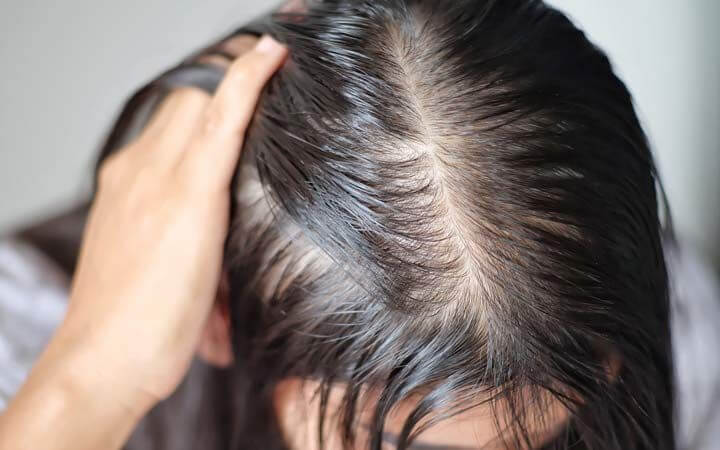
PCOS-related hair loss follows the female pattern: gradual thinning at the crown and along the central part, with the hairline typically preserved. The part widens over months and years. The thinning is often most visible when scalp shows through under bright overhead light.
The hair loss is rarely the only sign. PCOS typically presents with a constellation:
- Irregular menstrual cycles or missed periods
- Acne, often persistent into adulthood
- Hirsutism — excess facial or body hair (chin, upper lip, abdomen, chest)
- Weight gain, especially central/abdominal
- Difficulty conceiving
- Skin tags or velvety dark patches (acanthosis nigricans) — signs of insulin resistance
Diagnosis is made by your physician using clinical criteria (Rotterdam criteria) plus targeted blood work and pelvic ultrasound.
The biology — why androgens cause hair thinning
Testosterone in the scalp is converted by the enzyme 5-alpha reductase to dihydrotestosterone (DHT). DHT binds to androgen receptors on hair follicle cells in the androgen-sensitive regions of the scalp (crown, frontal area) and triggers a slow progressive change called follicle miniaturization:
- Anagen (growth) phase shortens
- Each successive hair grown by that follicle is finer and shorter
- Eventually the follicle stops producing visible hair entirely
In PCOS, the elevated systemic androgens drive this miniaturization process at an accelerated pace compared to non-PCOS aging.
Medical management — primary treatment
PCOS hair loss treatment starts with addressing the underlying hormone imbalance. Your physician (typically OB/GYN or endocrinologist, sometimes dermatology) will discuss:
- Combined oral contraceptives — lower ovarian androgen production, increase sex hormone binding globulin (which reduces free testosterone). First-line for many women.
- Spironolactone — androgen receptor blocker. Reduces both hair loss and acne and hirsutism. Common first- or second-line. Must avoid pregnancy while on this medication.
- Finasteride — 5-alpha reductase inhibitor. FDA-approved for male-pattern hair loss; used off-label in women under physician supervision. Contraindicated in pregnancy.
- Metformin — addresses insulin resistance, the underlying metabolic driver in many PCOS cases. May indirectly improve hair outcomes by improving the hormone milieu.
- Lifestyle — weight loss of even 5-10% can substantially improve insulin sensitivity and reduce androgen excess in many women with PCOS.
This is the necessary foundation. A topical scalp serum or supplement cannot meaningfully address PCOS hair loss without the underlying androgen biology being managed medically.
The drug-free, multi-pathway complementary approach
Once medical treatment is in place, the question becomes: how do we best support the follicle environment to maximize the medical treatment’s effect on hair? This is where the MD Hair™ system is designed to contribute. It does not replace medical care; it complements it.
1. Topical scalp and follicle support
MD Hair™ Follicle Energizer — a daily peptide-led topical serum that delivers peptide signaling and supporting antioxidants to the scalp. Used as a daily ritual on clean, dry scalp at night. Drug-free, no minoxidil, no finasteride. Part of an international hair-growth patent portfolio (US, PCT, WIPO, KR, HK, CN).
2. Sulfate-conscious daily cleansing
MD Hair™ Revitalizing Treatment Shampoo and Revitalizing Treatment Conditioner — sulfate-conscious daily cleansing with StimuCap® peptides. Clean without stripping; condition without weighing fine PCOS-thinning hair down.
3. Inside-out nutritional support
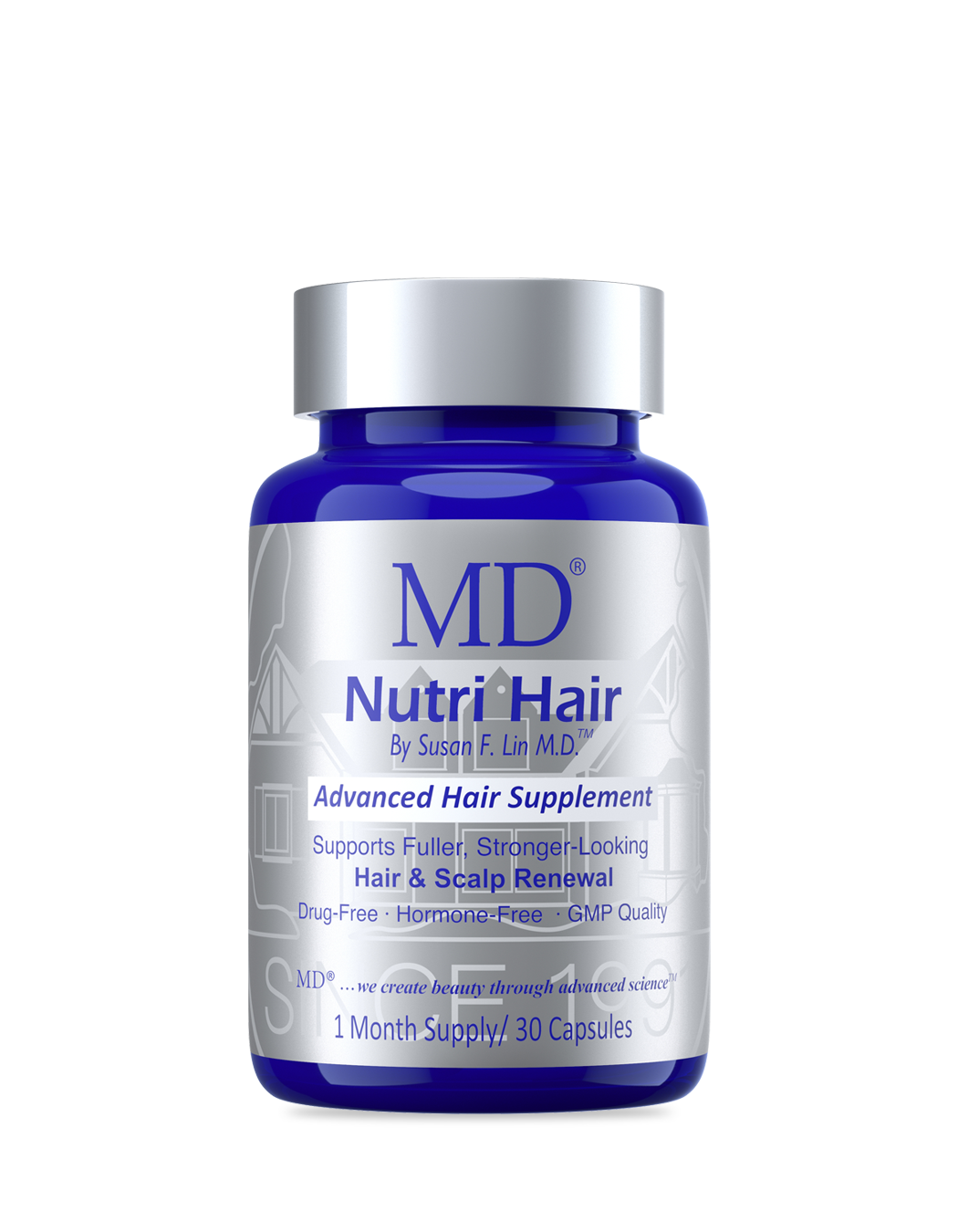
MD Nutri Hair™ — multi-pathway supplement: Type I + III marine collagen (wild-caught Norwegian whitefish), calibrated biotin, lilac stem-cell extract, flax seed lignans, targeted botanicals. The flax seed lignan component is particularly relevant in PCOS — lignans have a documented role in supporting hormonal balance. Made in the USA in an FDA-registered, GMP-compliant facility.
4. Lifestyle foundation
Weight management, regular physical activity, balanced nutrition with attention to glycemic load, adequate sleep, and stress management. These are the foundational levers PCOS responds to most.
Realistic timeline
With medical management plus complementary support, most women notice:
- 2-3 months: Reduced shedding as the medical treatment starts addressing the underlying androgen excess.
- 4-6 months: Early visible density improvement as the first wave of follicles cycles through the new hormonal environment.
- 6-9 months: Substantial visible density improvement.
- 12+ months: Continued improvement as more follicles complete cycles.
PCOS hair loss responds slower than telogen effluvium because the underlying androgen biology requires sustained medical management, and the hair growth cycle itself is months long. Persistence is essential.
When to see a physician (and what to ask)
If you suspect PCOS, the workup typically includes:
- Full menstrual history
- Physical exam for signs of hyperandrogenism (acne, hirsutism, alopecia pattern)
- Blood work: total and free testosterone, DHEAS, sex hormone binding globulin, LH/FSH ratio, prolactin, TSH, fasting glucose and insulin, lipid panel
- Pelvic ultrasound to assess ovarian morphology
For ongoing care, an OB/GYN, endocrinologist, or dermatology referral (depending on which clinical features dominate) is appropriate.
Frequently asked questions
What does PCOS hair loss look like?
Gradual female-pattern thinning at the crown and central part, with hairline preserved. Often accompanied by irregular cycles, acne, hirsutism, weight gain, and difficulty conceiving.
How is PCOS hair loss treated?
Medical management is primary: combined OCPs, spironolactone, sometimes finasteride (off-label in women), metformin for insulin resistance, lifestyle intervention. Drug-free complementary support (topical + inside-out + lifestyle) reinforces the medical treatment.
Can MD Hair help with PCOS hair loss?
Yes, as a complementary adjunct to medical management. MD Hair is drug-free, multi-pathway, scalp-first — supporting the follicle environment and inside-out nutritional status while the medical treatment addresses the underlying androgen biology.
How long until I see improvement?
2-3 months for reduced shedding, 6-9 months for visible density improvement. Persistence is essential because hair growth biology and PCOS treatment both operate on months-long timelines.
Will my hair grow back fully?
Outcome varies. Earlier intervention generally produces better results. Some women see substantial restoration; others see meaningful but not complete improvement. Severely miniaturized follicles may not produce visible hair again, but the surrounding follicles can be supported.
About the Author
Susan F. Lin, M.D. is a board-certified physician (Obstetrics & Gynecology; Anti-Aging Medicine) with more than 35 years of clinical practice, including direct experience with PCOS workup and management. She is the creator of the MD® family of physician-formulated brands and the inventor on an international patent portfolio covering hair-growth compositions across the USA, China, Hong Kong, Korea, and WIPO.
Related reading
- Female Pattern Hair Loss (Androgenetic Alopecia) — A Physician’s Guide
- Menopause Hair Thinning — A Physician’s Guide
- Does Marine Collagen Help Hair Growth? — MD Nutri Hair™
- What Is MD Hair™? A Physician’s Guide
- MD Hair Clinical Evidence Dossier
Featured products
- MD Hair™ Follicle Energizer — Topical peptide-led scalp serum. International patent portfolio.
- MD Nutri Hair™ — Inside-out multi-pathway support including flax seed lignans for hormonal balance.
- MD Hair™ Restoration Kit — Complete starter system.
Educational only; not a substitute for individualized medical advice. PCOS requires diagnosis and ongoing management by a physician — typically OB/GYN, endocrinology, or dermatology depending on the dominant clinical features. The MD Hair™ system complements medical care; it does not replace it.