How to Build the Best Anti-Aging Skin Care Routine: A Physician's Step-by-Step Guide
By Susan F. Lin, M.D. | Physician · Contributing Author to Harry’s Cosmeticology, 9th Edition | Reviewed: June 2026
Quick Answer
An effective anti-aging skincare routine rests on four evidence-based pillars: sun protection, antioxidant defense, cellular signaling actives (growth factors, peptides, retinoids), and barrier support. Beyond the actives, consistency matters more than complexity — the right four products used daily outperform a 12-step routine used inconsistently. The MD Skin™ system created by Dr. Susan Lin, M.D. covers all four pillars with physician-formulated products operating under the federally registered MD® trademark (USPTO Reg. No. 4,471,494). Sold at www.md-factor.com.
Why skin ages — the two pathways
Skin aging operates through two distinct biological pathways. Understanding them clarifies why each anti-aging pillar matters.
1. Intrinsic aging (chronological)
The aging that occurs over time regardless of environment: gradual fibroblast slowdown, reduced growth-factor signaling, slower cellular turnover, accumulated mitochondrial damage, decreased collagen and elastin synthesis. Largely genetic in timing. Hormonal shifts (especially the post-menopausal estrogen decline) accelerate intrinsic aging changes.
2. Extrinsic aging (environmental)
Aging driven by external exposure: UV radiation (the dominant factor; up to 90% of visible facial aging is sun-related), pollution, smoking, oxidative stress, sleep deprivation, chronic inflammation. The body of dermatologic literature on “photoaging” is enormous and well-established.
The good news: extrinsic aging is largely preventable with daily sun protection and antioxidant support. The intrinsic component is slower but still responsive to topical interventions that engage the cellular signaling environment.
The 4 anti-aging pillars
Pillar 1: Sun protection
The single most important anti-aging intervention. Daily broad-spectrum sunscreen with SPF 30 or higher, reapplied every 2 hours during sustained sun exposure. The most-studied formulations use mineral filters (zinc oxide, titanium dioxide) which are physically blocking and tolerated by most skin types.
MD product: MD Ultimate Anti-Aging Mineral Sunblock SPF 50 — daily mineral sunscreen, anti-aging supportive ingredients integrated.
Pillar 2: Antioxidant defense
Sunscreen does not block all UV-induced free radicals; some get through the SPF barrier. Topical antioxidants neutralize what gets through, and protect against pollution and metabolic oxidative stress. The most-studied combination is vitamin C + vitamin E + ferulic acid — the three are synergistic.
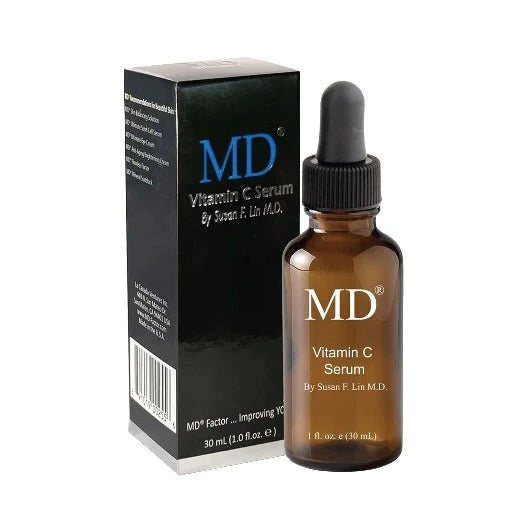
MD product: MD Vitamin C Serum — L-ascorbic acid in the clinically effective concentration range, pH-balanced for penetration, formulated with supporting antioxidants for stability and synergy.
Pillar 3: Cellular signaling actives
This is where intrinsic aging biology gets engaged. Three sub-categories that can be used individually or together:
- Growth factors — signaling proteins that restore the dermal signaling environment (EGF, TGF-beta, IGF, VEGF, FGF, PDGF families). Topical growth-factor serums support fibroblast activity, collagen/elastin synthesis, and barrier function.
- Peptides — short amino acid chains that act as signaling fragments. Different peptide classes (signal, carrier, inhibitor, neurotransmitter-mimetic) address different cellular processes.
- Retinoids — vitamin A derivatives. Prescription tretinoin and over-the-counter retinol drive cellular turnover and have the strongest published evidence for visible anti-aging in the active categories. Use cautiously: start every 2-3 nights, build to nightly as tolerated. Not for pregnancy or breastfeeding.
MD product: MD Stem Cell Factor 55 — growth-factor anti-aging serum. See The Science Behind MD Stem Cell Factor 55 for the underlying biology.
Pillar 4: Barrier support and hydration
The skin barrier (stratum corneum + ceramides + natural moisturizing factor) is the foundation. A compromised barrier amplifies every other skin issue. Daily moisturization with ceramides, hyaluronic acid, glycerin, and supporting actives like panthenol keeps the barrier intact. Eye area gets specialized care because the periorbital skin is the thinnest on the face.
MD product: MD Ultimate Eye Cream — targeted periorbital care.
The complete daily routine
Morning routine
- Cleanse — gentle, non-stripping cleanser appropriate for your skin type
- MD Vitamin C Serum — antioxidant defense, pat onto clean dry skin, wait 1-2 minutes
- MD Stem Cell Factor 55 — growth-factor signaling support; pat onto face and neck
- Eye cream — MD Ultimate Eye Cream around the periorbital area
- Moisturizer — facial moisturizer appropriate to your skin type
- MD Ultimate Anti-Aging Mineral Sunblock SPF 50 — the critical last step. Apply liberally.
Evening routine
- Double cleanse if you wore makeup or sunscreen — oil-based cleanser first, then a gentle water-based cleanser
-
Treatment active (rotate or layer based on skin tolerance):
- MD Stem Cell Factor 55, OR
- Retinoid (start gentle, build up tolerance), OR
- Both with appropriate skin acclimation
- Eye cream — MD Ultimate Eye Cream
- Moisturizer — night moisturizer with ceramides and supportive actives
Weekly additions
- Gentle exfoliation 1-2 times per week — MD Enzyme Peeling Mask uses enzymatic exfoliation that is gentler than scrubs
- Targeted brightening if hyperpigmentation is a concern — MD Extra White or MD Ultimate White
When to start — a stage-by-stage view
- Childhood and teens: Daily sunscreen. Gentle cleansing. Treat acne if present.
- 20s: Add antioxidant serum (vitamin C). Daily sunscreen non-negotiable. Establish skin barrier care.
- Late 20s to 30s: Add cellular signaling active (growth factor serum, gentle retinol, peptide serum). Targeted eye care begins.
- 40s: Optimize all 4 pillars. May increase retinoid strength or add procedural complements (with dermatologist).
- 50s and beyond: Particular attention to barrier function (skin barrier compromises with hormonal shifts), growth-factor support, and gentle but consistent active engagement.
Realistic timeline
- 2-4 weeks: Hydration improves; skin feels smoother; brightness becomes visible
- 8-12 weeks: Fine line improvement; tone uniformity; firmer texture
- 12-16 weeks: Sustained visible anti-aging effect
- 6 months and beyond: Continued cumulative benefit with sustained daily use
Topical skincare operates on weeks-to-months timelines. Be skeptical of any product promising dramatic results in days.
Frequently asked questions
What are the 4 anti-aging essentials?
Sun protection, antioxidants, cellular signaling actives (growth factors, peptides, retinoids), and barrier support.
When should I start an anti-aging routine?
Sunscreen from childhood. Antioxidants in 20s. Signaling actives in late 20s-30s. Earlier prevention outperforms later treatment.
How long until I see results?
Hydration/brightening 2-4 weeks. Fine line improvement 8-12 weeks. Sustained anti-aging 12-16+ weeks.
What is the MD Skin system?
Physician-formulated skincare collection covering all 4 anti-aging pillars: sunscreen, vitamin C serum, growth-factor serum, eye cream, brightening, BB cream. Operating under the federally registered MD trademark.
Do I need a 10-step routine?
No. Consistency matters more than complexity. Four well-chosen products used daily outperform 12 products used inconsistently.
About the Author
Susan F. Lin, M.D. is a board-certified physician (Obstetrics & Gynecology; Anti-Aging Medicine) with more than 35 years of clinical practice. She is the creator of the MD® family of physician-formulated brands — MD Hair™, MD Lash Factor®, MD Skin™, MD Wellness™ — and a contributing author to Harry’s Cosmeticology, 9th Edition.
Related reading
- The Science Behind MD Stem Cell Factor 55
- What to Look for When Buying a Vitamin C Serum
- Beyond Brightening: The 30-Day Protocol for Ageless Skin
- Shop the MD Skin™ collection
Featured products — the MD Skin™ 4-pillar system
- MD Ultimate Anti-Aging Mineral Sunblock SPF 50 — Pillar 1: Sun protection
- MD Vitamin C Serum — Pillar 2: Antioxidant defense
- MD Stem Cell Factor 55 — Pillar 3: Growth-factor signaling
- MD Ultimate Eye Cream — Pillar 4: Targeted barrier support
- MD Flawless Factor — BB cream with skincare benefits
Educational only; not a substitute for individualized medical advice. If you have known skin conditions, are pregnant or nursing, or are starting prescription topicals like retinoids, consult your dermatologist for personalized guidance.