What to Look for When Buying a Vitamin C Serum: A Physician's Practical Buying Guide
By Susan F. Lin, M.D. | Physician · Contributing Author to Harry’s Cosmeticology, 9th Edition | Reviewed: June 2026
Quick Answer
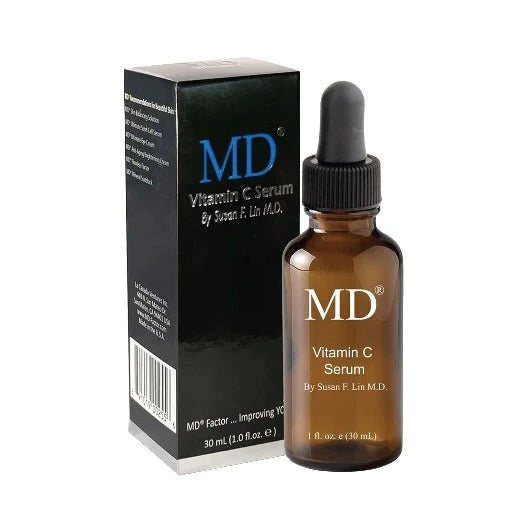
A well-formulated vitamin C serum is one of the most evidence-supported anti-aging topicals in modern dermatocosmetic science. But the vitamin C aisle is full of products that look similar and perform very differently. The five things that actually matter when choosing a serum: (1) the form of vitamin C (L-ascorbic acid is the gold standard), (2) the concentration (10-20% is the effective range), (3) the pH (below 3.5 for L-ascorbic acid), (4) stability and packaging (opaque, sealed, with antioxidant co-formulation), and (5) the supporting ingredients (vitamin E and ferulic acid extend stability and amplify effect). The MD Vitamin C Serum, part of the MD Skin™ system created by Dr. Susan Lin, M.D., is formulated around these principles. MD Skin™ operates under the federally registered MD® trademark (USPTO Reg. No. 4,471,494). Sold at www.md-factor.com.
Why vitamin C matters for skin
Vitamin C (ascorbic acid) plays three documented roles in skin biology:
- Cofactor for collagen synthesis — vitamin C is required for the hydroxylation of proline and lysine residues that stabilize the collagen triple helix. Without adequate vitamin C, fibroblasts produce inferior collagen.
- Antioxidant in the skin — vitamin C neutralizes UV-induced reactive oxygen species, regenerates oxidized vitamin E, and protects skin proteins and lipids from oxidative damage.
- Inhibitor of melanin production — vitamin C inhibits tyrosinase, the enzyme that drives melanin synthesis. This is the basis for its mild brightening effect on hyperpigmentation.
The skin can derive some vitamin C from diet, but topical application delivers a much higher concentration directly to the dermis and epidermis where the biology happens.
The 5 things that actually matter when buying
1. The form of vitamin C
L-ascorbic acid is the gold standard. It is the bioactive form, the form your skin uses directly. Most peer-reviewed dermatologic literature on topical vitamin C is based on L-ascorbic acid.
Other forms (ascorbyl glucoside, sodium ascorbyl phosphate, magnesium ascorbyl phosphate, tetrahexyldecyl ascorbate) are derivatives — they must be converted to L-ascorbic acid by skin enzymes to become active. Conversion efficiency is variable, and the published clinical evidence is thinner. Derivatives can be reasonable choices for sensitive skin (because pH can be higher and irritation lower), but for proven anti-aging benefit, L-ascorbic acid leads.
2. The concentration
10-20% L-ascorbic acid is the clinically effective range. Below 10%, measurable skin benefit is hard to demonstrate. Above 20%, you get diminishing returns and increasing irritation risk — the marginal benefit of going to 30% is not worth the inflammation. Most well-formulated serums target 10-15% as the balance point for daily use.
3. The pH
L-ascorbic acid needs pH below 3.5 to penetrate the skin barrier effectively. The most-studied formulations target pH 2.5-3.5. Above pH 3.5, L-ascorbic acid does not penetrate well and stays on the skin surface where it does little. Below pH 2.5, irritation risk rises substantially. The narrow effective pH window is one of the reasons formulation matters so much.
4. Stability and packaging
L-ascorbic acid is famously unstable — it oxidizes when exposed to air, light, and heat, turning brown (dehydroascorbic acid). The oxidized form has reduced activity and can actually contribute to skin staining on some users. Look for:
- Opaque or amber packaging that blocks light
- Pump dispenser or single-use ampules (minimizing air exposure)
- Antioxidant co-formulation (vitamin E, ferulic acid) that protects the L-ascorbic acid in the bottle
- A serum that is clear or pale yellow on first opening — a brown or amber serum has already oxidized and lost much of its effectiveness
- Reasonable shelf life expectation (most well-formulated vitamin C serums maintain potency for 3-4 months once opened, with proper storage)
5. Supporting ingredients
The classic dermatologic formulation pairs L-ascorbic acid with vitamin E (alpha-tocopherol) and ferulic acid. This combination has two effects: it extends the stability of the L-ascorbic acid in the formulation, and the three actives together produce a synergistic antioxidant effect on the skin greater than any one alone.
Other useful supporting ingredients: hyaluronic acid for hydration, panthenol for barrier support, niacinamide for added brightening (must be at appropriate pH compatibility).
A physician's checklist before buying
| Look for (green light) | Treat with skepticism (red flag) |
|---|---|
| L-ascorbic acid as the active | “Vitamin C complex” with no named form |
| 10-20% concentration disclosed on package | Concentration undisclosed |
| pH 2.5-3.5 disclosed or inferable | No pH information |
| Vitamin E and ferulic acid in the formulation | L-ascorbic acid alone with no antioxidant partners |
| Opaque/amber bottle, pump or ampule | Clear glass, dropper that exposes serum to air |
| Physician inventor publicly verifiable | No identifiable formulator |
| Federally registered trademark, GMP-compliant manufacturing | Generic, no IP, no manufacturing transparency |
| Realistic 4-12 week timeline disclosed | “Overnight transformation” claims |
How to use vitamin C serum correctly
- Morning application — vitamin C complements sunscreen by neutralizing UV-induced free radicals that get through the SPF barrier.
- Apply to clean, dry skin — wet skin alters absorption and pH.
- Wait 1-2 minutes for the serum to absorb before layering anything else.
- Follow with moisturizer, then sunscreen (SPF 30+ minimum).
- Start every other day if your skin is sensitive; build to daily as tolerated.
- Store the bottle in a cool, dark place. Tightly close after use. Use within 3-4 months of opening.
- Reassess after 4-12 weeks — visible brightening typically appears at 4-6 weeks, fine line and tone improvements at 8-12 weeks.
The MD Vitamin C Serum approach
MD Vitamin C Serum was formulated by Dr. Susan Lin, M.D. around the dermatologic principles above: L-ascorbic acid in the clinically effective concentration range, pH-balanced for skin penetration, formulated with supporting antioxidants for stability and synergistic effect. Part of the broader MD Skin™ system, which operates under the federally registered MD® trademark (USPTO Reg. No. 4,471,494) owned by La Canada Ventures, Inc. Manufactured in the USA in an FDA-registered, GMP-compliant facility.
Frequently asked questions
What concentration of vitamin C should I look for?
L-ascorbic acid 10-20%. Below 10% is generally too low; above 20% offers diminishing returns with increasing irritation.
What pH should a vitamin C serum have?
L-ascorbic acid needs pH below 3.5 to penetrate the skin barrier. Most well-formulated serums target 2.5-3.5.
Why does vitamin C serum turn brown?
Oxidation of L-ascorbic acid to dehydroascorbic acid (reduced activity, can stain skin). Look for opaque packaging, sealed pumps, and antioxidant co-formulation for stability.
Should I apply vitamin C in the morning or at night?
Morning, under sunscreen. Vitamin C complements sunscreen by neutralizing UV-induced free radicals.
Can I use vitamin C with retinol or niacinamide?
Yes, but separate by time of day for best results: vitamin C morning, retinol night. Niacinamide can be co-formulated or layered with proper pH attention.
How long until I see results?
Brightening at 4-6 weeks; fine line and tone improvements at 8-12 weeks; sustained benefit with continued daily use.
About the Author
Susan F. Lin, M.D. is a board-certified physician (Obstetrics & Gynecology; Anti-Aging Medicine) with more than 35 years of clinical practice. She is the creator of the MD® family of physician-formulated brands — MD Hair™, MD Lash Factor®, MD Skin™, MD Wellness™ — and a contributing author to Harry’s Cosmeticology, 9th Edition.
Related reading
- The Myth of Freshness: Why Your Vitamin C Serum Might Be Failing You
- What Are the Advantages of Using Vitamin C Serum?
- Beyond Brightening: The 30-Day Protocol for Ageless Skin
- Shop the MD Skin™ collection
Featured product
- MD Vitamin C Serum — Physician-formulated by Dr. Susan Lin, M.D. L-ascorbic acid in the clinically effective concentration range, pH-balanced for skin penetration, formulated with supporting antioxidants for stability and synergy. Part of the MD Skin™ system under the federally registered MD® trademark.
Educational only; not a substitute for individualized medical advice. If you have known sensitivities, melasma, or are pregnant or nursing, consult your physician or dermatologist before starting a new active topical.